
On the Pro Leisure Circuit, I’m spending a lot of time in random coffee shops. Cafe Dio in Los Gatos. Long-standing desk. View of the redwoods in front of my high school. Can recommend.
It’s been a while since I’ve documented what’s in my bag, but there have been several recent notable updates worth discussing, as well as a seismic bag shift, which is where we’ll start.
TUMI: Harrison Warren Backpack: I’ve been Team Tom Bihn for a long time. I recently purged the closet, and the pile of Tom Bihn bag-related detritus was impressive. The shift to Tumi was driven by the same design sensibility that drove me to Tom Bihn. As I wrote about, I have an existing bias against backpacks because of high school — lugging around bags of books in huge canvas monstrosities.
While Tom Bihn was my stalwart for years, it also started to look baggy to me. Roundish, lumpish, and just hanging on my back. On a post-pandemic trip to London, I walked into a Tumi store (a little drunk) and started talking backpacks.
Enter: the Harrison Warren.
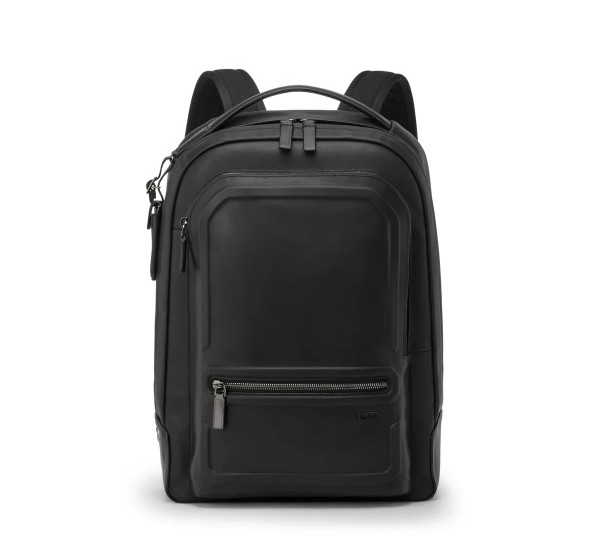
On top of a very clean nylon and leather-highlighted design, the Harrison Warren offers less space. Pardon? You read that right, less space. No matter how diligent I am about what I put in my bag, I simply accrete stuff over time. A notebook, a book, a stack of papers, that thing I need to give to someone sometime. Stuff, stuff, stuff. Harrison Warren offers ample pockets, sleeves, and space for all my stuff, but it is not spacious. It is not designed to lug many pounds of random crap across the Continent which means I am required to be more stuff-thoughtful.
Equally important to the capacity is useful details. If you are considering a Tumi, you must go in and talk with the salesperson. The amount of consideration that has gone into a Tumi product is immense. They know you are an engineer, writer, or actor who needs quick access to their stuff at random times. Their bags are built for these humans, but unless someone explains these features… you’re going to think it’s just a pocket.
I’m coming up on three years with Harrison Warren, where I’ve been on hundreds of trips. Build quality — not an issue. He looks great.
ANKER: Prime Charger: Charging is a way of life. Each time I find myself with a dead device, I go on the operational offensive. What change do I need to make to ensure this never happens again? The short answer is: I have a backup of just about every critical device in my bag. There are two phones, a MacBook, an iPad, two AirPods, and so forth. Yes, this increases weight, but I DO NOT CARE. I AM NOT SHOWING UP IN LONDON POORLY EQUIPPED, OK?
Even with a healthy set of backups, all of these devices need charging. I was using this USB-C hub for years. Still, I was vaguely aware that different chargers provided different wattages, so I began investigating my vast array of white Apple charging bricks.
Let’s start with a vent: I am intimately aware of how much Apple cares about design, but it’s baffling how hard it is to read the text on these bricks1. It’s designed to be unobtrusive, I get it, and most humans don’t care about how many watts are pumped through each brick, but when it matters, you sure do.
A charging primer:
- On top of the number of watts provided by your charger, there is also the amount of charge your device can accept. For example, your fancy new iPhone 17 Pro Max can accept 40W maximum, but your friend’s iPhone 17 can only accept 27W. Even with a much larger battery, the Pro Max will charge faster with the right charger.
- Lithium batteries charge on a curve with the first 50% being the fastest, 50-80% slowing down, and the charge to 100% taking relatively a very long time. For example, my iPhone 17 Pro Max takes 20 minutes to get to 50%, 41 minutes to 80%, and an hour and 31m to 100% with the best charger. You have two critical questions when your device is dead: how long until it’s working again, and how can I get the most charge in the least amount of time?
Again, most humans don’t care about all these details, which is fine. The issue is that most humans are grabbing that 20W charger out of their box of chargers and plugging in their device, and not knowing they are wasting a lot of time charging. If they’re plugged in all night, who cares? However, in a pinch, you can drastically affect the speed of the charge. We’re talking 47% faster on that first 50% charge. Huge.
Anker has been my go-to not-Apple device charger for many years. Their most recent Anker Prime Charger has a lot to like:
- Three USB-C ports at 140W each. (Yes, most devices can’t suck down this much power, but 140W covers everything you currently have and likely covers future toys you will have.) When two ports are active, it splits ~78W + ~76W. Three ports: ~60W + ~50W + ~35W. No USB-A. You don’t need it. You’re covered.
- More importantly to me, there is a display on this device that shows how many watts are being delivered via each port. Also, when you plug a device in, it smiles at you. Aw.
I had Grumbles build you a comprehensive cheat sheet of the Apple charging situation, comparing the 20W with Anker’s latest for all your Apple hardware. It’s illuminating — view it or grab the PDF.
UBIQUITI: Travel Router: The house is all in on Ubiquiti. I have a rack down in one of the closets, which powers a set of APs and cameras across the property. What was a messy mesh of Eeros was replaced with a rock-solid blanket of Wi-Fi and wired goodness2.
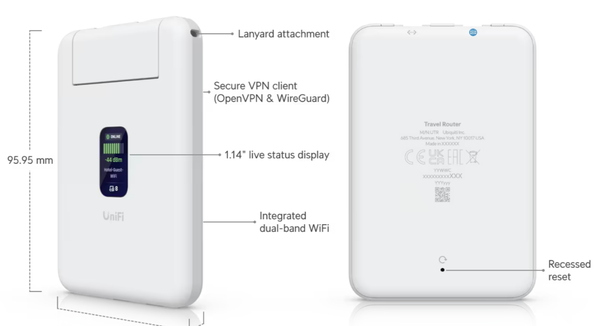
Now that I’m on the Pro Leisure Circuit, my home network is also work. This means when I’m at my favorite coffee shop, it’d be very handy to have access to all my home resources. Ubiquiti already makes this pretty easy with Teleport VPN links, but with the Travel Router, they make it even simpler.
This small battery-less device connects with whatever untrustworthy Wi-Fi is available and, using Teleport/WireGuard (same thing, different branding), creates a secure tunnel back to your home network. When configured anywhere on the planet, my home Wi-Fi shows up just like I’m at home. The trade-off is a network performance hit from the encryption, but the peace of mind is worth it.
The Travel Router has not earned itself a place in the bag, yet. Two outings so far, and I’ve spent more time tinkering with the device rather than appreciating it. We’ll see.
The rest of the contents of the Tumi are presented with light commentary:
- MacBook Pro. The new one. Space Black. Yes, the Air is lovely, but I love the weight of the Pro.
- iPhone Pro Max — atomic orange, of course. iPhone 17 backup — just in case.
- iPad Pro 13 — mostly a content consumption device.
- A small see-through bag with back-up cables, converters, and stuff necessary to present.
- An orange notebook for random thoughts.
- Clif Bars. Because sometimes you get hungry.
- (5) Zebra Sarasa Gel .5. Best gel pen on planet earth.
- Altoids. Because toothbrushes are often distant.
- A Tide pen. Because I can be sloppy, and I like nice button-up shirts.
- A black Sharpie for when I need to yell.
- An iPhone MagSafe Battery — they stopped making these. I don’t know why. I’ll buy a Kuxiu S4 when it’s available. Stay tuned.
With all of these items in this bag, it weighs just under six pounds. There’s an international variant of this bag build out, which includes international converters as well as additional backup cables, because somehow other people need these items more internationally.
The best part? This bag is sitting right there. It’s ready to go whenever. Will I need all that stuff? Rarely. Will I grin when out of nowhere someone needs an extra phone? I will. Will I slowly become the guy at the conference who can help you with whatever? Yes, I am that guy.
- Someone wrote about this elsewhere, but recent charger bricks moved from a dark grey, unreadable text to a light grey, even more unreadable text. It’s horrific. If you have a questiona about a charger, the Apple support page offers actual readable text ↩
- The administration interfaces for Ubiquiti are a nerd work of art. ↩
The amount of power and charging carried, this is starting to sound like one of those modern soldier loadout problems, where they keep adding batteries.